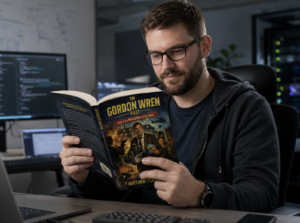
There is a certain kind of frustration that only an IT professional truly understands. Everything appears to be working. Nobody has changed anything. The problem definitely started “for no reason.” Then, after twenty minutes of looking around, somebody quietly admits they installed an update, moved a device, clicked a link, or unplugged something because the cord looked unnecessary.
IT professionals live in a world where tiny details matter.
A strange login time matters. A cable going somewhere it should not matters. A user behaving differently matters. A process taking an unusual route through a system matters. Sometimes the biggest problems announce themselves with flashing alerts. Other times, the only warning is a small detail that simply does not fit.
That is one reason The Gordon Wren Files: Book 1: The Wrong Man at the Door feels strangely familiar to people who work in technology.
Among spy thriller books, this one takes a different approach to its hero. Gordon Wren is not introduced as an elite operative with years of classified training. He is a middle-aged kitchen appliance salesman who has spent years paying attention to loading areas, hotel corridors, product demonstrations, expensive homes, packaging, service routes, and all the irritating details most people ignore.
Then he notices something is wrong.
For an IT professional, that may be the most relatable beginning to a spy thriller imaginable. 💻🕵️
The Person Who Notices the Weird Thing Usually Saves the Day
Information technology is a massive field. The broad definition of information technology described by Wikipedia covers the use of computers and telecommunications systems to create, process, store, retrieve, and exchange information. In practice, the person working in IT often becomes the unofficial professional observer of everything strange happening inside an organization.
They notice the printer making a different sound.
They notice the server behaving differently at 2:13 every morning.
They notice one employee receiving a suspiciously large number of password reset requests.
They notice traffic coming from a place it has never come from before.
They notice that the explanation does not quite match the evidence.
Gordon Wren operates in much the same way.
He notices packaging that looks wrong. He understands when a route makes no practical sense. He recognizes when ordinary service traffic does not feel ordinary. He pays attention to the way people carry objects and the importance they quietly place on them.
None of these details seem dramatic by themselves.
Together, they become a pattern.
That is the part IT professionals will recognize immediately. Technology work often rewards the person willing to look at ten individually boring details and realize they are collectively terrifying.
Gordon does not walk into a room and announce that he has solved an international conspiracy. He looks at what is happening and becomes increasingly irritated because people are doing things that make no practical sense.
Honestly, that sounds like at least half of IT work.
Pattern Recognition Is More Exciting Than It Sounds
The phrase “pattern recognition” does not immediately sound like the beginning of a fast spy thriller. It sounds more like something written on a conference presentation while everyone checks email under the table.
In reality, pattern recognition is one of the most important skills in both technology and security.
The Cybersecurity and Infrastructure Security Agency regularly publishes information about cyber threats and the constantly changing methods used to target systems and infrastructure. IT and security professionals cannot rely entirely on waiting for someone to hand them a perfect explanation of an attack. Suspicious behavior has to be recognized, investigated, and placed into context.
The Wrong Man at the Door turns that basic idea into physical action.
Gordon sees logistics.
He sees movement.
He sees ordinary equipment being used in ways that do not match its purpose.
The story moves through luxury spaces, hotels, service environments, and an international summit. Criminal activity hides behind things designed to look normal. Catering equipment, conference stock, domestic hardware, and routine service traffic become pieces of a much larger operation.
The professionals around Gordon keep assuming he must have advanced training.
He does not.
He has simply spent years watching how things are supposed to work.
That experience gives him a baseline.
When something breaks the baseline, Gordon notices.
Every experienced IT professional has developed a similar internal alarm. It is difficult to explain to someone who has not spent years working with systems. Sometimes a screen just looks wrong. A request sounds strange. A sequence of events feels slightly out of order.
There may not be enough information to explain the problem yet.
There is enough information to keep looking.
Gordon Wren Basically Performs Human Incident Response
Incident response sounds much more official when it appears in a cybersecurity document.
The National Institute of Standards and Technology incident response resources focus on helping organizations prepare for, detect, respond to, and recover from cybersecurity incidents. Good incident response depends on understanding what happened, limiting the damage, and making intelligent decisions while information is still incomplete.
Gordon Wren would probably hate sitting through an incident response meeting.
He would also be surprisingly good at the actual work.
Throughout The Wrong Man at the Door, Gordon is repeatedly dropped into situations where the available information is incomplete. Other people have assumptions. Some have professional training. Some have criminal plans. Gordon has the irritating ability to recognize when their assumptions do not line up with reality.
Then everything gets worse.
This is where the story becomes particularly entertaining for IT readers.
A technology crisis rarely arrives at a convenient time with complete documentation. The person handling the problem often has to diagnose while responding. The system is still failing. People are still calling. Management wants an update. Someone has already restarted something important without telling anyone.
Gordon faces his own version of that chaos.
He is trying to understand a situation while the situation continues moving around him.
His greatest advantage is not that he knows everything.
It is that he refuses to pretend something makes sense when it clearly does not.
That stubbornness becomes incredibly useful.
IT Professionals Already Know That Ordinary Things Can Hide Serious Problems
A compromised environment does not always look compromised.
That idea has become familiar to anyone who follows computer and technology reporting through resources such as ACM TechNews. New technology, emerging security concerns, artificial intelligence, software vulnerabilities, and computing research constantly remind professionals that complex problems can exist underneath systems people use every day.
The same tension runs through The Wrong Man at the Door.
The setting is not built entirely around dark underground bunkers and walls covered in classified maps.
Ordinary service traffic becomes suspicious.
Premium domestic hardware matters.
Conference stock matters.
Hotel corridors matter.
Loading routes matter.
Things designed to fade into the background suddenly deserve attention.
IT professionals understand this concept almost instinctively.
The laptop sitting quietly on a desk can become an entry point.
The email that looks almost identical to a legitimate message can become a security incident.
The third-party tool everyone forgot about can become a vulnerability.
The account created years ago and never removed can suddenly matter.
Normal is useful camouflage.
Gordon’s talent is recognizing when something is trying too hard to look normal.
That makes the book particularly satisfying for people who spend their careers examining systems, processes, and human behavior.
Competence Is Gordon Wren’s Accidental Superpower
Many spy heroes are impressive because they can fight six people, jump from a building, land on a motorcycle, and continue a phone conversation without sounding slightly winded.
Gordon Wren is impressive because he understands how things should be loaded.
That may not sound as cinematic.
It becomes surprisingly dangerous.
People working in technology often develop deep knowledge in areas that everyone else considers boring until something fails. Network architecture is boring until the network stops. Backups are boring until data disappears. Access controls are boring until an unauthorized person gets access.
The skills required for cybersecurity work can include knowledge of operating systems, network architecture, communication protocols, security auditing, encryption, and other technical disciplines, as described in this IEEE Spectrum look at cybersecurity careers.
Expertise often means knowing more about a specific process than everyone else in the room.
Gordon has expertise.
It simply comes from an unexpected place.
He has spent years in environments where rich people barely notice him. He has been around demonstrations, kitchens, loading areas, delivery routes, and badly managed events. While other people ignored him, Gordon watched.
Years of being overlooked gave him an unusually detailed understanding of how ordinary systems operate.
Then criminals make the mistake of operating inside those systems.
Gordon notices.
It is an excellent reminder that useful expertise does not always arrive wearing the uniform people expect.
The Story Understands That People Are Usually the Strange Part of a System
Computers are blamed for an extraordinary number of things humans do.
The computer deleted the file.
The system changed the password.
The email sent itself.
The website somehow ordered twelve identical products.
Somewhere nearby, an IT professional is staring silently at a screen.
Security professionals know technology cannot be separated from human behavior. The Microsoft Security Blog frequently covers threats, identity, ransomware, security operations, and the techniques attackers use against organizations. Behind many technical incidents sits a human decision, mistake, assumption, or deliberate action.
The Wrong Man at the Door understands human behavior.
Gordon watches people as carefully as he watches equipment.
He notices when someone handles an object as though it matters more than it should. He notices when movement feels deliberate. He notices the gap between what people say they are doing and what their actions suggest.
That gap matters.
IT professionals see versions of it constantly.
A user says the strange email looked legitimate but also admits the sender was unfamiliar.
Someone insists nobody shared the password, then explains that the entire department uses the same login.
A person claims the computer suddenly became slow shortly after installing a completely free application recommended by a popup featuring several exclamation points.
People are unpredictable.
Gordon has spent enough time around them to expect that.
The book uses this understanding for both suspense and humor. Gordon is frequently surrounded by people who believe he is doing something brilliant. Gordon is mostly annoyed that nobody else has noticed the obvious problem.
That is an incredibly IT-professional kind of hero.
The Wrong Man at the Door Rewards Curiosity Without Making It Feel Like Homework
Technology professionals spend enormous amounts of time learning.
The field changes too quickly to stop.
New systems appear. New threats develop. New tools become popular. Artificial intelligence changes workflows. Cloud environments evolve. Security concerns shift. Resources such as the Google Cloud Security and Identity blog continue documenting developments around security, identity, cloud technology, and emerging risks.
After spending a day reading technical documentation, most people do not want their evening entertainment to feel like another certification course.
The Wrong Man at the Door avoids that problem.
It plays with ideas IT professionals appreciate without turning the story into a technical manual.
Observation matters.
Processes matter.
Logistics matter.
Small inconsistencies matter.
Human behavior matters.
The reader gets the satisfaction of following someone who notices problems without having to read forty pages explaining network protocols.
Gordon’s thinking feels practical.
He sees something.
He knows it is wrong.
He tries to determine why.
Then several highly trained and extremely dangerous people misinterpret his competence as evidence that he is some kind of covert professional.
The misunderstanding keeps growing.
Gordon keeps surviving.
The conspiracy keeps unraveling.
The result is a spy thriller built around one of the most underrated professional skills in existence: paying attention.
Being Ignored Can Give Someone an Excellent View of the System
One of the most interesting things about Gordon Wren is the way other people underestimate him.
He is a salesman.
He is middle-aged.
He works around kitchen appliances.
He does not look like the person who should derail a sophisticated operation.
That is exactly why he becomes so effective.
People reveal things around someone they do not consider important.
Organizations develop similar blind spots.
The employee who works with the same system every day may recognize a problem before leadership does. A help desk technician may notice repeated complaints that point to a larger issue. A systems administrator may see an unusual event hidden inside thousands of ordinary logs.
The person closest to the process often sees details other people miss.
Gordon has spent years close to processes.
He understands the difference between efficient movement and awkward movement. He understands how equipment is handled. He understands what belongs in certain spaces.
The criminals are thinking about the operation.
Gordon is thinking about the details.
The details betray them.
For an IT professional, that is a deeply satisfying kind of victory.
This Is a Spy Hero Built for People Who Notice Everything
The Gordon Wren Files: Book 1: The Wrong Man at the Door works for IT professionals because Gordon’s greatest strength is familiar.
He notices.
He notices broken patterns.
He notices poor logistics.
He notices objects being treated differently than they should be.
He notices when explanations do not match reality.
Then he keeps looking.
Gordon is not trying to become an intelligence operative. He is trying to understand why supposedly competent people keep doing things badly. Unfortunately for several criminals, Gordon’s irritation comes with a remarkable ability to expose problems.
IT professionals may recognize themselves in that frustration.
There is always one strange detail.
There is always one unexplained event.
There is always one person insisting everything is fine while the evidence quietly disagrees.
The Wrong Man at the Door takes that familiar professional instinct and drops it into a fast, funny international spy thriller filled with criminal logistics, compromised spaces, confused intelligence officers, and a hero who keeps ruining sophisticated plans by understanding how ordinary things are supposed to work.
Sometimes the person who saves the day is not the person with the most advanced training.
Sometimes it is the person standing in the corner thinking, “That should not be there.”
For IT professionals, Gordon Wren may feel less like an unlikely spy hero and more like a coworker who finally had a very, very interesting week. 🕵️♂️💻